
Published:
October 13, 2025
Author:
Anthony Del Porto

When people think about climate and sustainability the first two things that come to mind are electricity and mobility. Both of these are really just proxies for energy, which is how most people think about impacting climate: not burning fossil fuels for energy, either to create electricity or move their car. However it misses the much bigger picture, and this is seen in how investment has been allocated in climate.
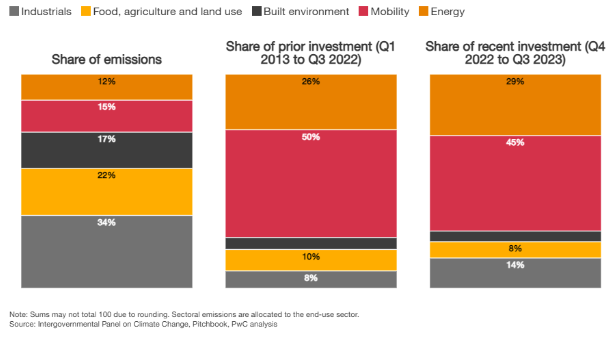
Industrials alone (at 34%) represent more emissions than energy generation and mobility combined yet they haven’t received even a fifth of the investment that’s gone into energy and mobility. This means that from an impact standpoint Industrials present a much larger theme in which to generate impact. However there’s more to it than that: industrial sustainability is not only a great place to create impact; industrial sustainability presents an opportunity to create impactful solutions that just make the most business sense.
First there’s the spreadsheet logic: since there are fewer people investing in this sector, there’s less competition and therefore better valuation entry points. However, not only are industrials not “popular” in venture investing, they’re massive industries. Software (where most people think about venture investing) was estimated to be a $730B industry globally in 2024 (source). That’s pretty good, but when you think about the fact that global manufacturing is estimated at $14 trillion (source), software seems almost cute. Plastics alone were $624B in 2023 (source), just 15% short of all of software. The upside opportunities are huge for solutions in industrials.
So clearly the markets are huge and more like blue ocean markets (from a startup competition point of view), but industrial sustainability provides another advantage: Sustainable solutions require you to throw out the old paradigm of how we make things entirely and look at completely new methods. This doesn’t lead to incremental 0.5%-1.0% improvements (which most mature industries would kill for). Completely starting over leads to step-change improvements in cost and performance. A great example of this is Rushnu. They make chlorine. Just plain old chlorine, a $42B industry by the way (source). However, they make chlorine sustainably, capturing carbon in the process. As a result of their new method, they can make chlorine using half the energy and at half the price of anyone else. By looking for sustainable solutions they found a way to make a major global commodity chemical at a price that no one else can touch.
Industrial sustainability is a game of “better, faster, cheaper”. However due to the scale of industrial production the outcomes can be massive and you don’t need to take on market risk. Then when you look at the potential impact that can be had, it’s massive. Steel, cement, and chemicals production represented 6.3 giga tons of carbon in 2022 (IEA but made beautiful by Canary Media). Industrial sustainability marries impact and returns better than probably any other sector.

Anthony Del Porto is the Founding GP of BetterWay. His professional background ranges from mechanical engineering in production and design environments to COO of a venture backed startup. He now invests in Industrial Sustainability solutions, the more overlooked the better.